How Tamaga works
Follow a guest request from condition to decision.
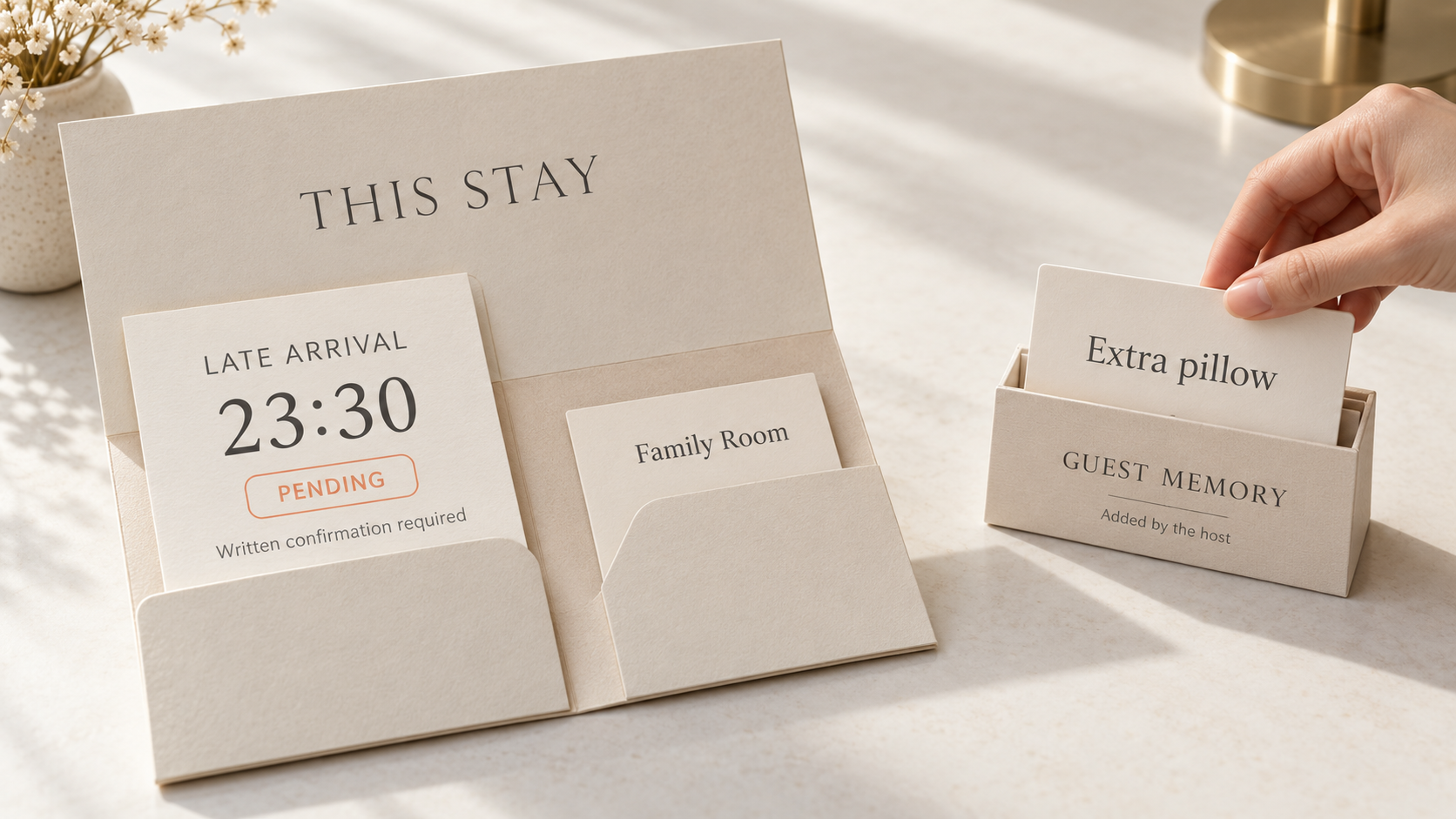
A family expects to arrive at 23:30. The property’s published condition says arrivals after 20:00 require written confirmation. Follow how that condition stays visible, how the request reaches the person responsible, and what remains unresolved until someone decides.
This walkthrough uses the fictional Hotel Demo. The public pages and dated staff captures show different parts of the implementation; the complete sequence is an illustrative workflow.
Promise Thread
Arrival after 20:00 requires written confirmation.
One stay
Keep this stay’s request separate from checks of public wording.
House Record
Approved meaning
Guest View
Condition visible
Host Desk
Accountable action
Channel Lens
Representation check
The room suits the family. Their arrival still needs a decision.
Scenario facts
The outstanding question is whether the property has agreed to this family’s arrival arrangement.
Fictional example
- Party
- 2 adults + 2 children
- Room
- Family Room
- Room Fit
- Proper sleeping places for four.
- Honest limitation
- One open-plan sleeping space.
- Expected arrival
- 23:30
- House policy
- Arrival after 20:00 requires written confirmation.
23:30 activates the condition. It does not confirm the arrangement.
The Stay Request and Host Attention stay linked, but they are not the same state. The decision role is known while Host Attention remains open and unclaimed and the guest request remains pending.

- Request received
- Host work unfolds
- Awaiting the host
- House condition
-
Arrival after 20:00 requires written confirmation from the house.
- Stay Request
-
PENDING
Received by the house
Expected arrival: 23:30
- Host Attention
-
OPEN
Decision Authority: Person on duty must confirm or decline.
-
01 Maintain the condition
The property records its arrival condition, where it came from, who is responsible for it and when it needs review. In Tamaga, the House Record carries that approved wording. Approval to publish the condition does not approve an individual guest’s request.
-
02 Show the condition before the guest relies on it
The guest should be able to see the room’s relevant characteristics and the arrival condition while planning the stay. Clear wording helps them understand what requires agreement. It does not establish availability or confirm the arrangement.
-
03 Record the request as pending
The family gives 23:30 as its expected arrival time. In this example, the Stay Request records the proposed arrangement as pending. The associated Host Attention item identifies work that needs a response. A receipt acknowledges that the request has reached the property.
-
04 Make responsibility visible
A responsible staff member takes ownership of the work. The team can see who needs to act and what remains unresolved. Assigning or completing a staff task does not, by itself, confirm the guest’s arrival.
-
05 Record the decision and communicate it
An authorized person confirms or declines the stay-specific arrangement. That decision belongs with the request. Written confirmation must reach the guest through the property’s agreed process: recording a decision and communicating it are separate actions. The arrival decision also remains distinct from the reservation and payment records.
Keep the relevant context with this stay
The room, party, dates, expected arrival and decision give staff the context needed to handle the request.
Any reuse of personal context on a later stay requires its own scope and review. The contact record, reservation and arrangements for one visit retain different responsibilities.
Keep system responsibilities clear
| Information or action | Responsibility |
|---|---|
| Published room information and conditions | The property’s designated owner, maintained through the House Record. |
| Availability, rates and reservations | The booking system chosen for the deployment: a Tamaga-native foundation or the property’s existing systems. |
| Payment authorization and settlement | The payment provider. |
| A stay-specific arrival decision | An authorized person at the property. |
The workflow can sit within either deployment pattern.
Integrations explains how those responsibilities are assigned.
Check the public wording separately
The property may also need to examine how its arrival condition appears elsewhere.
Channel Lens compares approved wording with selected representation evidence. If a description drops the requirement for written confirmation, the finding identifies something to investigate and correct.
This check concerns the general published condition. The family’s private arrival decision remains with their request. Correcting a source and checking another representation are separate pieces of work.
What the recorded evidence shows
The recorded examples below show approved conditions, representation findings and separate staff records. Their original captions identify the capture dates and scope.
These are separate fictional records. Together, they illustrate the distinctions the product maintains; they do not document one live guest journey or a current external-channel check.
Start with the House’s approved wording.
The wording approved for publication, including the requirement for written confirmation. The screenshot was captured on 2 November 2026.
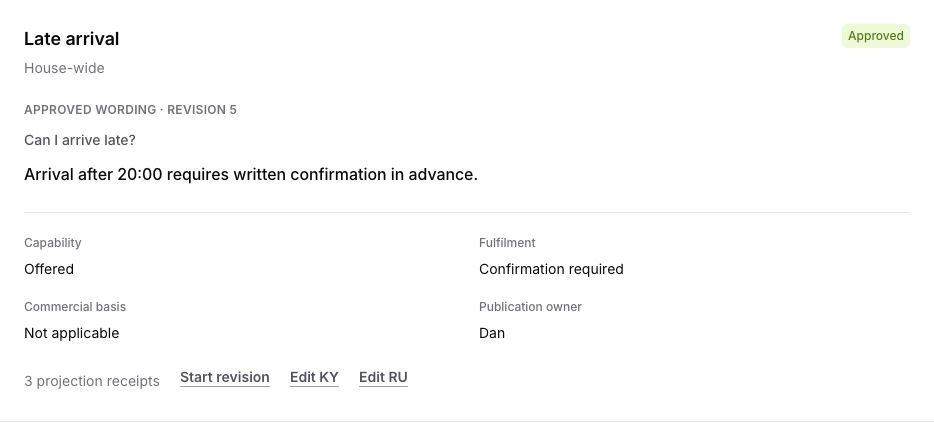
Fictional House policy record in the authenticated Tamaga Hotel Demo. Revision 5 is approved for publication and states that arrival after 20:00 requires written confirmation in advance. Approved applies to the governed wording—not to any guest’s arrival request. Dan is the publication owner; no Host Attention assignment is shown.
Captured 2 November 2026.
Retain what the representation check found.
A synthetic observation dated 6 August, associated with the policy revision used for that check. The screenshot was captured on 2 November 2026.
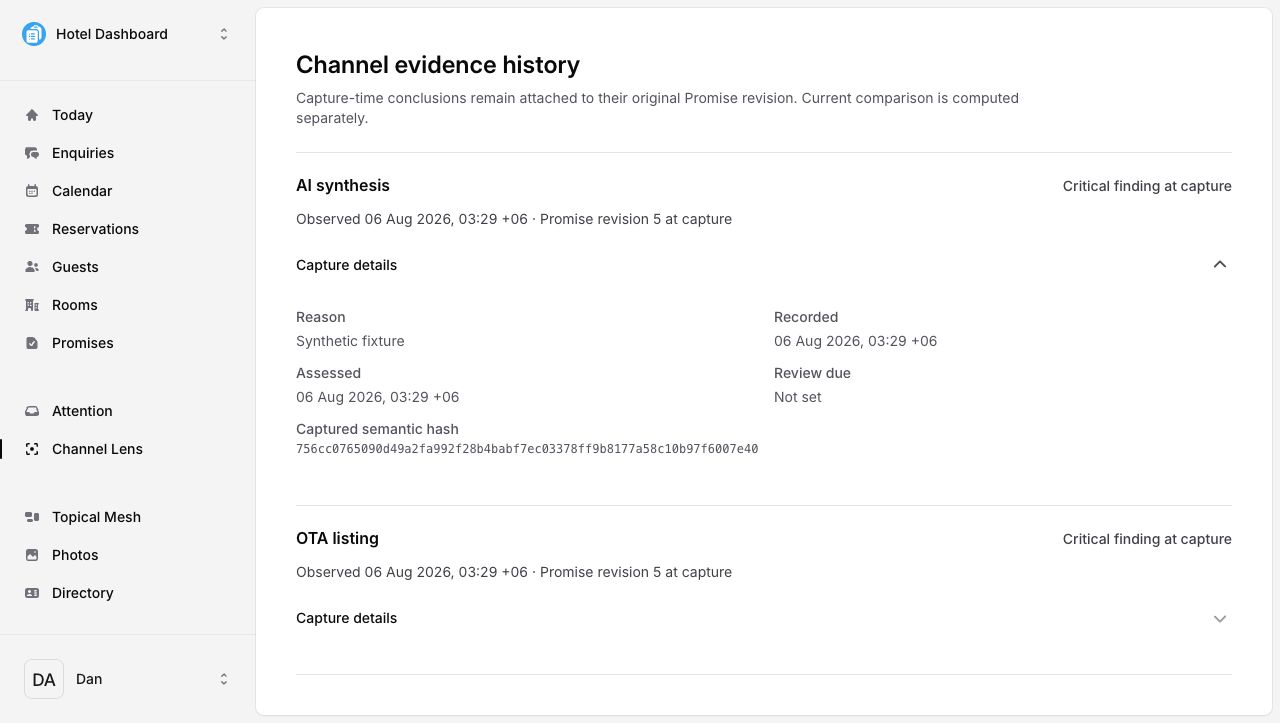
Historical synthetic Channel Lens evidence in the authenticated Tamaga Hotel Demo. The capture was observed on 6 August 2026 and remains attached to Promise revision 5, with a critical finding recorded at capture time. It is not a current channel sync or current conclusion, and it represents no real guest, property or OTA listing.
Captured 2 November 2026.
Keep preparation accountable.
A separately authored task, its responsible person, instruction and unresolved blocker.
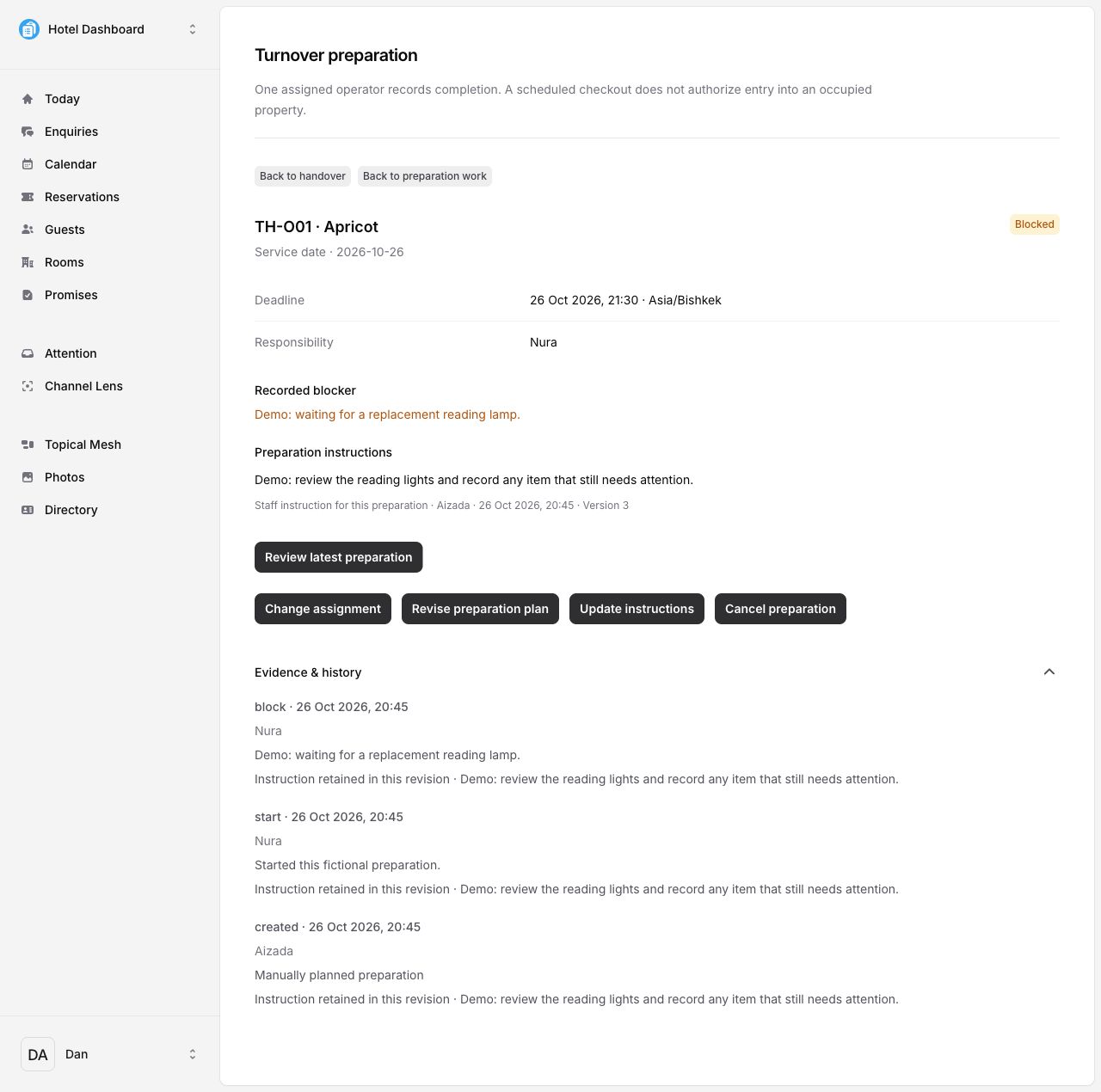
The preparation history retains the recorded blocker, work transitions and original authored instruction. Captured 26 October 2026 from the local Hotel Demo; fictional records.
Review the history before reusing guest context.
How earlier preferences and decisions retain their recorded status.
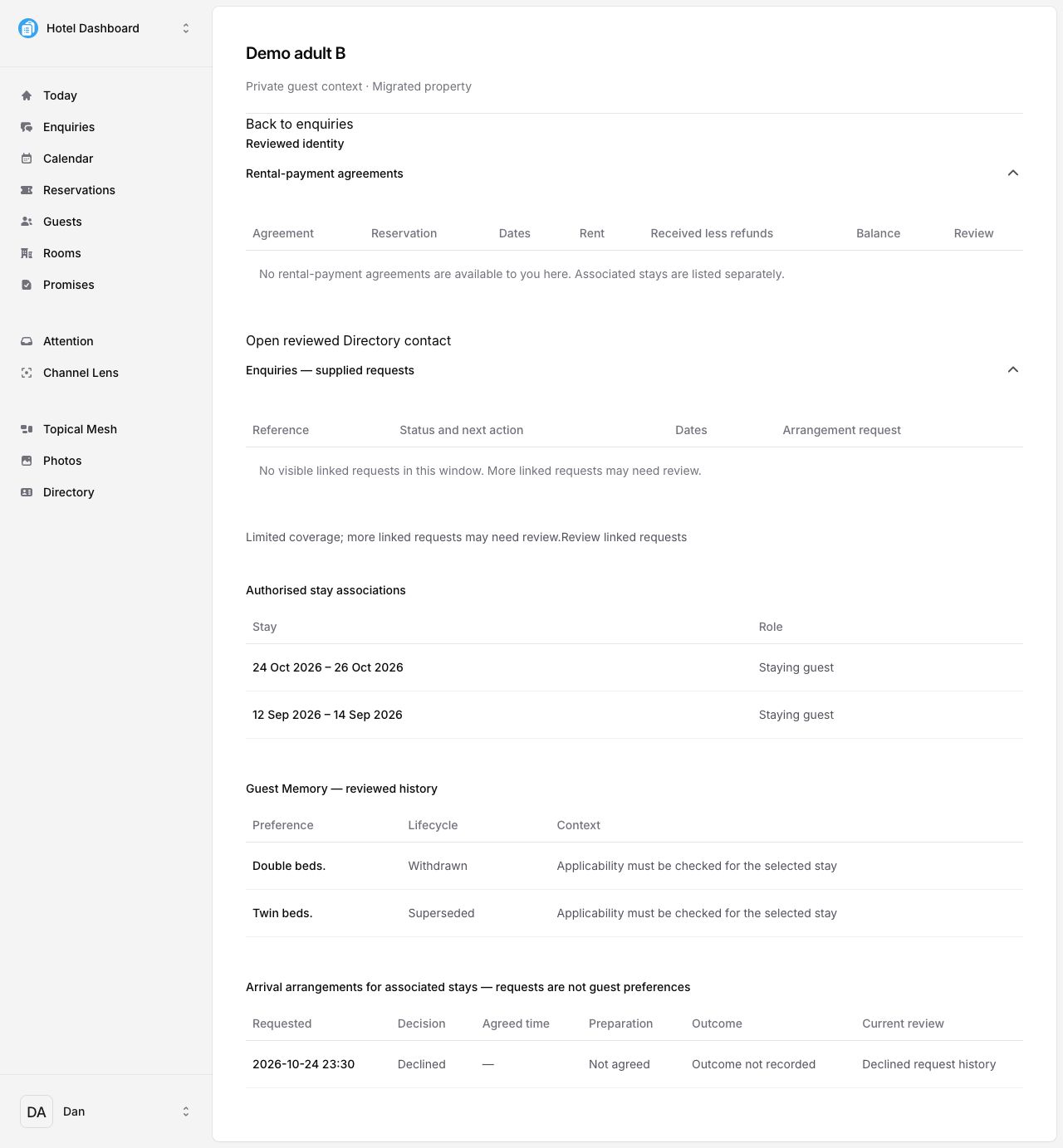
A Guest Card preserves the distinction between historical preferences, their recorded status and an arrival decision. Captured 26 October 2026 from the local Hotel Demo; fictional records.
Choose the next useful step
- Understand the product’s fit: Hospitality overview explains who it serves and its two deployment options.
- Assess your existing setup: Integrations explains connections, ownership and implementation boundaries.
- Inspect the examples: Hotel Demo offers public room information, supporting records and dated staff evidence.
If your immediate question concerns how one public condition is represented, the Seven-Version Snapshot provides a separate, human-reviewed diagnostic.
Which guest arrangement needs clearer handling at your property?
Bring one example: what the guest asks, which condition applies, who decides and how the answer reaches the guest.