Travel Knowledge Score · Self-check

Find the travel information worth checking next

Your team knows when a place can be visited, what a route involves and who can answer a practical question. The Travel Knowledge Score helps you examine how clearly your website carries that information.

Answer twenty questions about the information you publish and maintain. Your result brings together what you report as working, where you see gaps and what you still need to check.

The self-check is an active prototype. It works from your answers and does not independently inspect your website.

Twenty questions across ten topics. See a short answer summary first. Your work email and consent are required to view the full profile and checklist.

Start with examples from your own website

Keep a few useful pages open while answering: a place or activity, practical visiting information, a partner contribution and a translated page where available.

Look at what someone can actually find, understand and reuse. Can they identify the place? Understand the conditions? Check an important statement? Follow a useful next step?

Choose “Not sure” when you cannot establish the answer. It records something to investigate and does not count as a weakness. Each question includes guidance on what to check.

Self-check

Start the self-check.

Start the self-check

Fictional example — not your result

What the full result looks like

20 answers completed. 19 describe a known state. One answer needs a check.

  • Names and identityYes, clearly
  • Reusable informationYes, clearly
  • Connections between pagesYes, clearly
  • FindabilityYes, clearly
  • Evidence behind claimsNot sure
  • Seasonal adviceYes, clearly
  • Local partnersYes, clearly
  • Sources and reuseYes, clearly
  • Useful next stepsYes, clearly
  • Consistency across languagesPartly
One example: an answer worth checking

Is it clear which claims need review before stronger public language is used? Not sure

A useful next check Choose a claim awaiting approval. Check whether its review status and responsible owner are clear before stronger wording is published.

Start the self-check

Answer all 20 questions. Work email is required for the full result. Choose “Not sure” when you cannot tell.

We save your answers and contact details to provide your result and respond to this request. Dan reviews completed self-checks and may email you about a useful next question. Submitting does not create a subscription.

Names and identity

Look at how clearly you identify places, offers, partners and other things you describe.

Can the platform clearly name the places, routes, partners, offers, claims, and media it knows about?

Choose a place, route, partner, offer, claim and media item on your site. Check whether each is clearly named and identifiable without guessing from surrounding copy.

Are important entities reused consistently across pages instead of being rewritten differently each time?

Find the same place or offer on two pages. Compare its name and key facts, and check whether both use the same source or must be updated separately.

Reusable information

Check whether important facts can be maintained and reused beyond a paragraph of text.

Does the platform use structured fields or metadata so facts can be understood beyond page prose?

Open the editor for one offer. Look for facts such as its name, location, dates or conditions in separate fields or metadata, rather than only in a paragraph.

Can key facts be reused by teams, search engines, and AI-assisted systems without manual interpretation?

Ask a teammate to reuse one approved fact on another page or in another system. Check whether they can obtain it without interpreting or copying page prose.

Connections between pages

Follow the links that connect a decision to its explanation, context and proof.

Do routes, claims, partners, seasons, and source notes connect to the context that supports them?

Choose a route or claim and follow its connections to timing, partners and source notes. Note any supporting context that is missing or hard to reach.

Findability

Check whether your organization, places and services are easy to identify and cite.

Can systems identify the organization, its places, and its services without guessing?

Compare your organization name, places and service names across headings, contact information and any structured data. Note conflicts or missing identity that a system would have to infer.

Are core entities and services discoverable in ways search engines and AI-assisted systems can cite?

Choose a core place or service. Check that it has an accessible, descriptive page with clear names and a stable URL that someone could cite.

Evidence behind claims

Look for the source and review responsibility behind important claims.

Can important claims trace to evidence, source, date, or owner?

Pick one important claim. Look for supporting evidence, a source, a date or a responsible owner, and note what you can actually trace.

Is it clear which claims need review before stronger public language is used?

Choose a claim awaiting approval. Check whether its review status and responsible owner are clear before stronger wording is published.

Seasonal advice

Check whether timing advice explains the reasons, trade-offs and operating context.

Does the platform explain timing as travel judgment rather than only as best-time-to-visit copy?

Read one seasonal advice page. Check whether it explains why a period suits a traveler and describes trade-offs or cautions, beyond naming months.

Do seasonal recommendations connect to routes, risks, partners, traveler needs, or operating constraints?

Follow one seasonal recommendation to its route, risks, partners, traveler needs or operating constraints. Note where those connections are missing.

Local partners

Look at how you explain partners’ knowledge, roles and responsibilities.

Are local partners visible as knowledge assets, not just suppliers or names in copy?

Open a partner reference. Look for the partner’s local knowledge or expertise, rather than only a name, logo or supplier listing.

Are partner roles, expertise, and responsibility clear enough to support trust?

For one offer, check whether readers can tell which partner delivers it, what expertise they bring and who is responsible.

Sources and reuse

Check whether other people can verify and responsibly reuse your information.

Can journalists, partners, and AI-assisted systems cite facts, images, quotes, rights, or source notes easily?

Choose a fact, image or quotation someone might reuse. Check for an identifiable source and usable credit or rights guidance alongside it.

Are source, correction, media, and contact paths clear when someone needs to verify information?

Try to find where to verify a fact, report a correction, request media material and contact a responsible person. Note any missing or unclear path.

Useful next steps

Follow what happens when a traveler moves from information to an enquiry or other action.

Does the public platform show signs of connection to enquiry, product, workflow, or traveler logic?

Follow one public offer into its enquiry or request path. Check whether its information and conditions carry into that next step and connect to the relevant product or workflow.

Can a user understand the next useful operational step without leaving the platform confused?

On one key page, ask a new reader what to do next and what they expect to happen. Compare that expectation with the actual next screen or response.

Consistency across languages

Compare the meaning and review process across markets and languages.

Does meaning stay governed across markets and languages?

Compare the same offer or claim in two languages. Check names, numbers, conditions and intended meaning, and identify which source governs any difference.

Are translated claims, names, seasonal advice, and source terms reviewed instead of only rewritten?

Pick a recent translated change. Check whether a person reviewed its claims, names, seasonal advice and source terms before it was treated as approved.

Work through ten short steps, with two questions in each. See a short summary, then enter your work email to view the full profile and checklist. Name, website and extra context are optional. “Not sure” stays unscored and comes with a practical check.

We save your answers and contact details to provide your result and respond to this request. Dan reviews completed self-checks and may email you about a useful next question. Submitting does not create a subscription.

The example and initial summary do not create a saved request or send email. Answers may be held temporarily so you can edit them. Requesting the full result saves your answers, result, contact details, method versions, language and submission time and notifies Dan. IP addresses are used to limit abuse. Your consent covers saving and responding to this request.

A saved result can be viewed by anyone with its private link for 60 days. Link expiry does not delete the saved request. Contact [email protected] to request correction or deletion. Do not enter guest records, credentials or unrelated confidential information.

What your result helps you examine

Your full result contains a profile across ten topics, the answers you supplied and practical checks for reported gaps or uncertainty.

The topics cover names and identity, reusable information, connections between pages, findability, supporting evidence, seasonal advice, local partners, sources and reuse, useful next steps and consistency across languages.

Use the profile to select a manageable piece of work. You might clarify a visit condition, identify the source behind a claim, explain image permissions or connect a page to the practical information its reader needs.
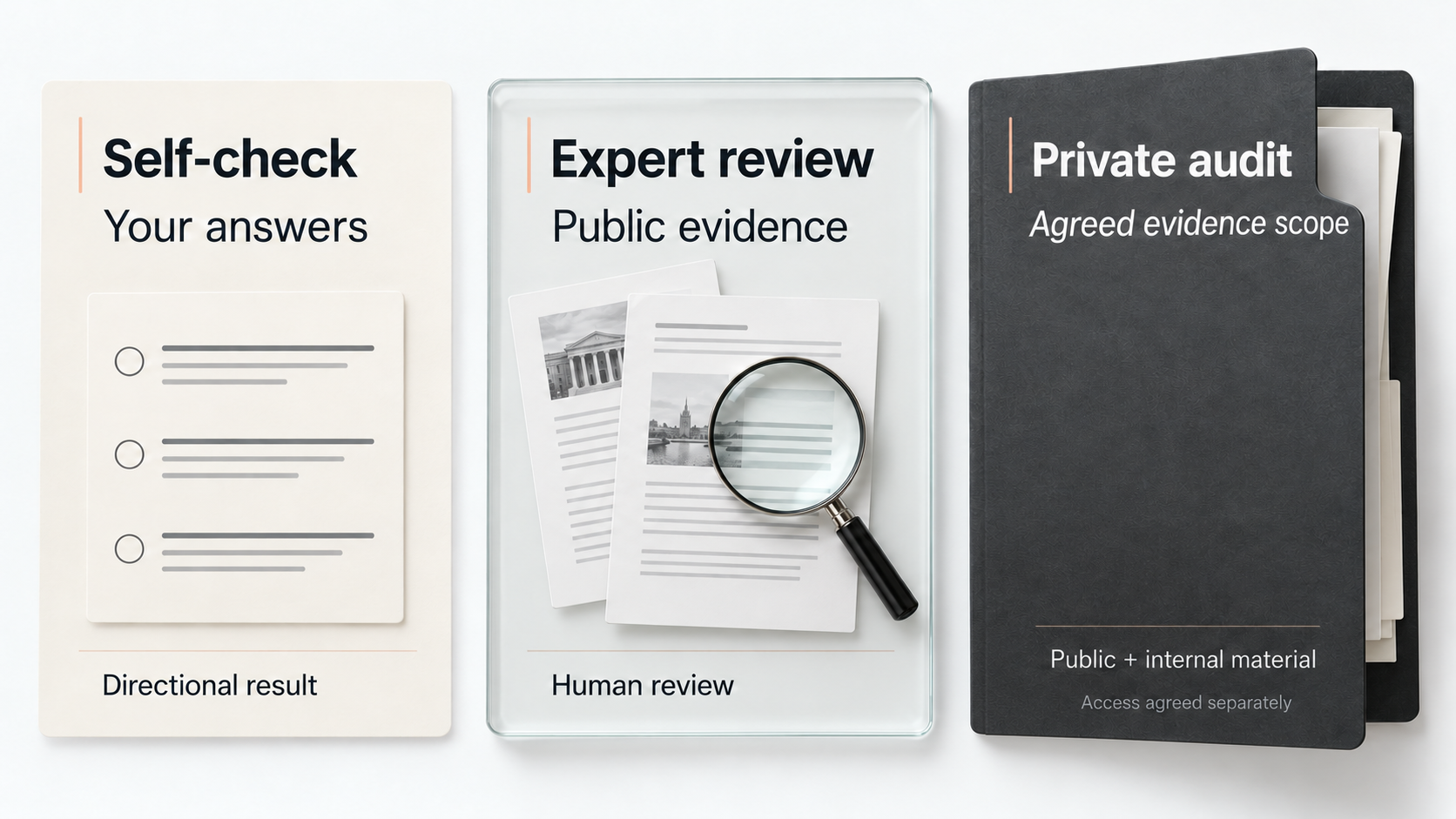
Self-check uses your answers for a directional result. Expert review uses public evidence and human review. Private audit uses public and internal material under separately agreed access and scope.
Illustrative evidence paths: self-reported answers, human review of public evidence, and a separately scoped private audit. These paths do not represent completed assessments.
AI-generated illustration · Tamaga

An uncertain answer can lead to a useful correction

Imagine a cultural association offering guided workshop visits. Its main page explains that visits require advance arrangement. A translated page says only “Visits available.”

If the editor has not compared those pages, “Not sure” accurately describes what remains unchecked. The language guidance gives them a concrete task: compare the versions with the maintained source.

The useful outcome is to restore the arrangement condition, check the enquiry path and identify which other versions need the correction. The self-check prompts that investigation; the editor establishes what is happening.

How to interpret the score

An overall score and band appear only when all twenty answers describe a known state. “Known” means you selected an answer other than “Not sure”; the website evidence has not been independently verified.

Where answers remain uncertain, use the topic profile and practical checks to establish what is happening before comparing priorities.

When the result identifies one uniquely weakest mapped area, it may suggest a possible first system. Equally weak areas remain visible without selecting one automatically. Treat any suggestion as a starting point for examining examples, responsibilities and the changes your existing website can support.

The result is directional. It does not establish a benchmark ranking or certification.

01

0 <= score <= 20

Early mapping needed

02

20 < score <= 40

Emerging source readiness

03

40 < score <= 60

Useful public knowledge base

04

60 < score <= 80

Strong source-readiness signals

05

80 < score <= 100

Source-system potential

Possible first system

From signal to system.

An uncertain signal needs clarification. A known weakness is a starting point for review, not an automatic prescription.

From signal to system.
Weak or unclear signal Possible first Tamaga system
Entity / Structure Travel Knowledge Graph
Proof / Citation Proof-Led Newsroom or Claim Ledger
Season Season Graph
Partner Partner Passport System
Public Operational Signals Travel Operations Backend
Language Multilingual Governance
Discovery AI Travel Visibility Audit or Knowledge Graph sprint
Mesh Topical Mesh + Travel Knowledge Graph

Turn a finding into a practical next step

Choose one consequential question and examine the pages involved.

  • An important statement needs support: Source Confidence helps assess what the available material establishes.
  • Readers struggle to reach the next answer: Topical Mesh helps clarify page responsibilities and contextual connections.
  • Language versions carry different conditions: Multilingual Content explains how to maintain meaning and useful visitor paths.

Check the revised information where people encounter it. A correction in one source may leave other pages, translations or partner material needing attention.

Bring a question you want to investigate

If you would like help interpreting your profile, bring the relevant pages, the uncertainty and the decision you need to make.

A human review begins with an agreed question, evidence scope and deliverable. Questions involving internal material require separately agreed access. Completing the self-check does not commission a review.