A fictional hotel used to document unfinished hospitality software states.
Release, demo and contact
The story in one paragraph
Tamaga Hotel is a fictional ten-room reference environment documented in a public release about situations hospitality software often hides. In the bounded release scenario, a family room physically fits four guests but still carries an open-plan limitation; a 23:30 arrival request remains pending until somebody authorized confirms it; and Channel Lens compares the House position “Arrival after 20:00 requires written confirmation in advance” with the fictional OTA statement “Check-in is available at any hour; late arrival is guaranteed.” Visitors can inspect Guest View and Host Lens today; the request, open Host Attention state and altered representation are historical synthetic release evidence, not an anonymous live workflow.
Important: Tamaga Hotel is fictional.It is a synthetic reference environment, not an operating hotel. The guests, policies, scenarios and deliberately altered representations used in the demo are demonstration data. They must not be cited as evidence about a real property, OTA, guest population or commercial outcome.
Tamaga Hotel is fictional
There is no trading hotel, real guest, real payment, fabricated review history or OTA reputation behind the demo. The fictional boundary is deliberate.
The demo uses a ten-room reference property
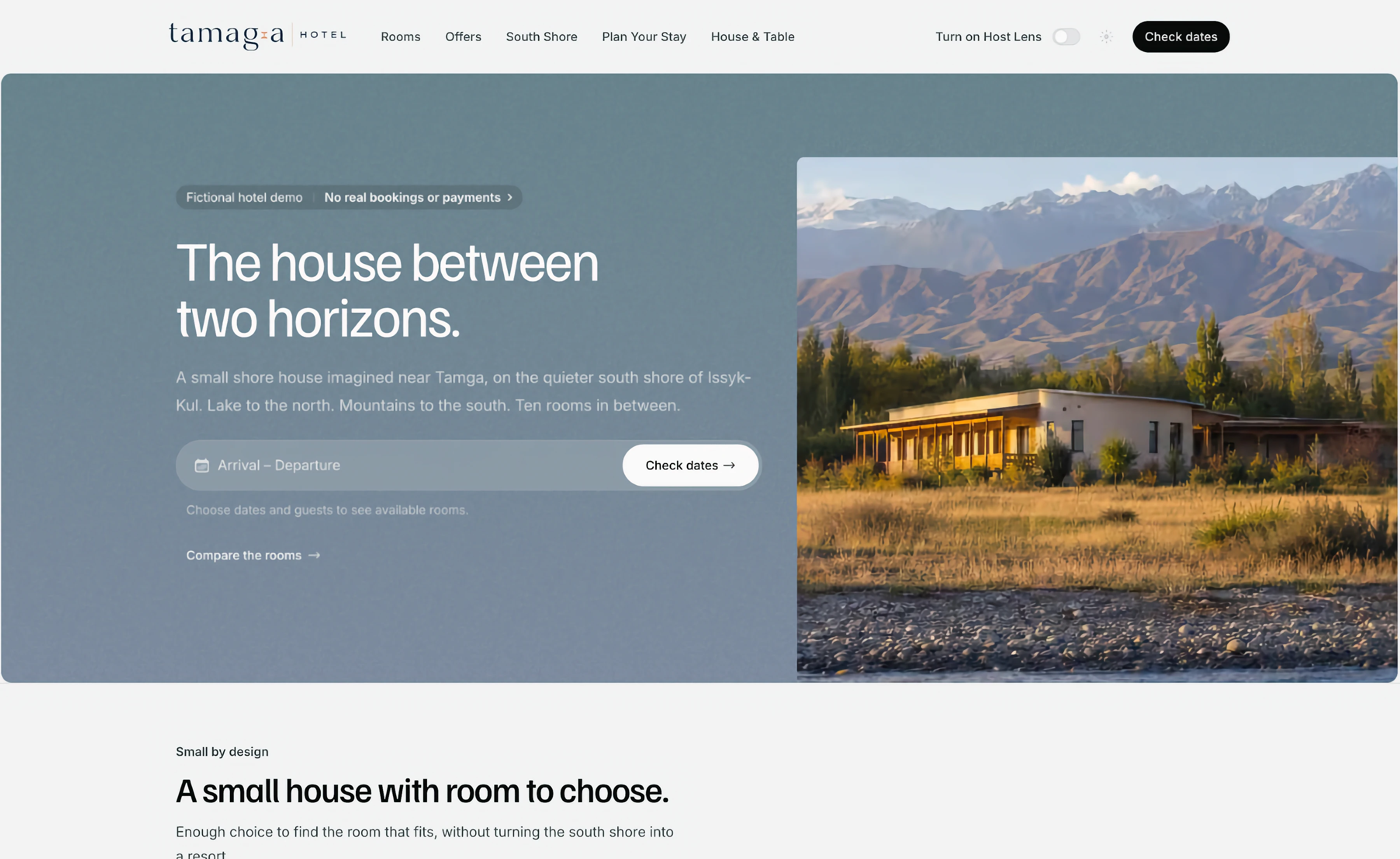
Tamaga Hotel is modeled as a fictional owner-operated ten-room property near Tamga on the south shore of Issyk-Kul.
Pending is an intentional state
In the bounded release scenario, a 23:30 late-arrival request remained pending until a responsible person confirmed or declined it. Host Attention could be open while the guest outcome was still unresolved.
Room Fit preserves limitations
The synthetic Family Room physically fits four people, but the demo also preserves the fact that it is one open sleeping space rather than treating capacity alone as sufficient.
Channel Lens tests meaning, not word matching
The release scenario compares the House position “Arrival after 20:00 requires written confirmation in advance” with the fictional OTA statement “Check-in is available at any hour; late arrival is guaranteed.” The request condition has not merely disappeared; it has become a guarantee. The maintained public Channel Lens explanation is available, while the operational comparison workspace remains permission-controlled.
These are software-demo facts, not claims about hotel revenue, conversion, guest satisfaction or real-world OTA behavior.
Use the release image with its context
Clear permission, clear boundaries
The downloadable Tamaga Hotel Demo release image on this page may be used without charge for editorial coverage of Tamaga, Tamaga Hotel or the subjects discussed in the accompanying release.
Please credit Tamaga. Cropping for layout is permitted.
- Do not materially alter the image or crop out any visible fictional-demo qualification.
- Do not present the fictional Tamaga Hotel as a real operating property.
- Commercial, advertising, resale, dataset-training or unrelated promotional use is not included in this permission.
- For another use or a higher-resolution file, contact [email protected].
Four lines for the story
“A real hotel is a poor place to manufacture failure states in public. Fiction gives us a safe boundary where the software can be inspected without pretending that synthetic evidence is market evidence.”
“A request is not a confirmation. A staff task can be open while the guest answer is still pending. We wanted the demo to keep that unfinished state visible instead of quietly turning work in progress into a promise.”
“We do not want Tamaga to become another source of truth competing with the hotel’s existing systems. The harder job is to make the handoffs visible, and to know when a person still has to decide.”
“Meaning can drift without any sentence becoming obviously false. If “late arrival requires confirmation” becomes “late check-in available”, the wording is close, but the promise is not.”
Five specific ways into the release
- 01Counter-demo: why hospitality software should demonstrate uncertainty, failed fit and pending states rather than only successful checkout.
- 02Synthetic proof environments: why a fictional hotel may be more honest than a fake customer case when testing hospitality software in public.
- 03Human authority in agentic travel: what happens when an AI, booking flow or structured representation can describe the stay but cannot legitimately confirm the next action.
- 04Independent hotels and stack boundaries: why clearer guest promises do not require replacing the PMS, booking engine, payment provider or channel manager.
- 05Representation drift: how “late arrival requires confirmation” can become “late check-in available” without an obvious factual contradiction, yet materially change what the guest expects.
The company in full
Tamaga is a travel knowledge infrastructure company building systems that connect what travel organizations know, what travelers need to understand, how that knowledge is represented to machines, and who is responsible for the next action. Its current hospitality work focuses on independent properties, where room fit, guest promises, operational attention and representation integrity can be made explicit without replacing the hotel's existing booking and operational stack.
Short boilerplate: Tamaga builds travel knowledge infrastructure for independent hospitality and tourism, connecting guest understanding, machine-readable representation, operational authority and human attention around consequential travel decisions.
Tamaga Hotel Demo is implemented in Drupal and combines structured editorial content, room availability, commerce, CRM, multilingual publishing and Tamaga’s Promise, Attention and Channel Lens components. The release scenario uses synthetic data and does not query a live OTA or AI service.
The person behind the work
Dan Metille is the founder of Tamaga, working at the intersection of travel, hospitality, semantic architecture, Drupal and structured knowledge. His background spans tourism marketing, travel platforms and operational systems, with a long-standing focus on helping independent travel organizations represent what they know without losing the human judgment behind it.
Read Dan’s full bioWhat the demo does not prove
The demo does not establish that a real hotel will increase conversion, reduce staff time, improve guest satisfaction, experience real-world channel drift, or benefit commercially from Tamaga. It also does not claim that automation should replace host judgment.
- Beta release
- August 6, 2026
- Demo v1 public release
- September 17, 2026