Research Briefings
The website no longer owns the final sentence
A guest plans to arrive at 23:30. Their room reservation is confirmed.
- Author
-
- Publisher
- Published
- 2026-08-31
- Updated
- 2026-11-07
A short listing description says:
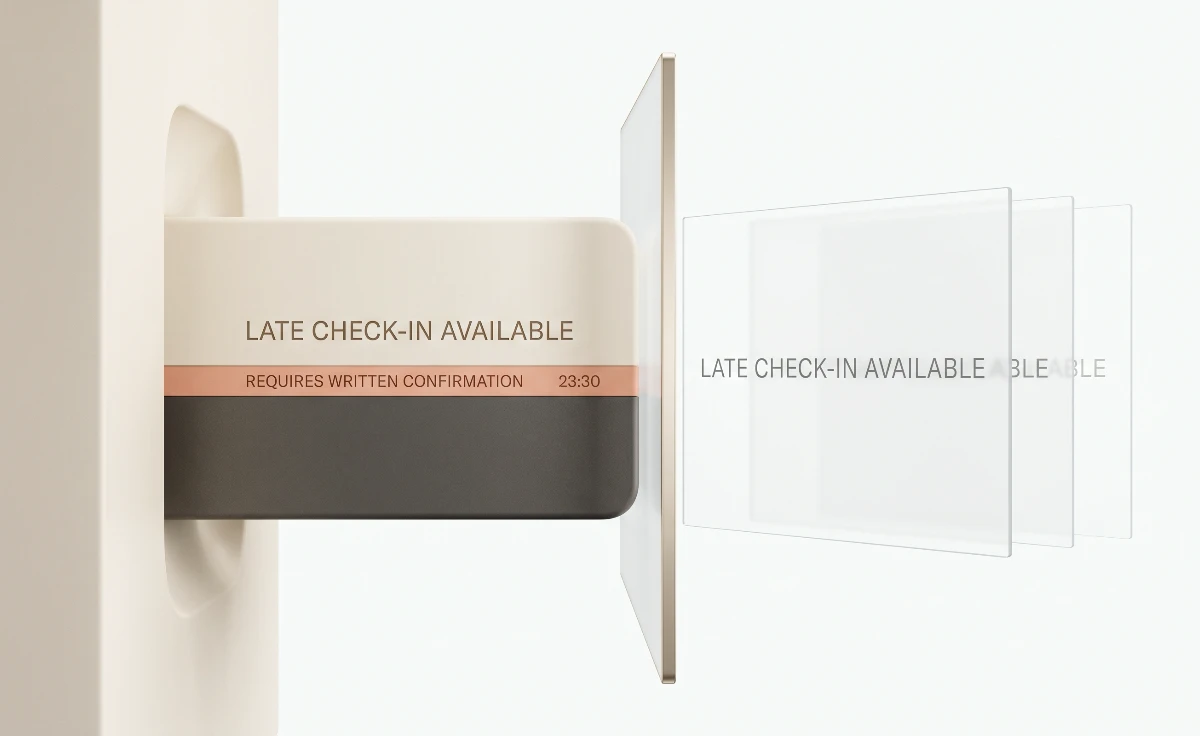
Late check-in is available.
The property’s policy says:
Arrival after 20:00 requires written confirmation.
The reservation alone does not establish whether that late arrival has been confirmed.
This is a fictional Tamaga Hotel example. Its useful question is simple: what would the guest reasonably understand, and what still needs to happen before they rely on that answer?
The answer may come from your website. It may also come from a booking platform, a message, a search result or an AI-generated response.
Your website can be correct without being the place where the guest forms their final understanding.
The final sentence is the one the guest relies on
By “final sentence,” I mean the answer someone takes into their decision.
It might be “We can arrive after the train gets in.” Or “That room will work for our family.” It may never appear in those exact words on any page.
The guest assembles that understanding from what they encounter.
Hotels have never controlled every description of their property. Guidebooks, agents, directories, reviews and personal recommendations already stood between the property’s explanation and someone’s expectations. Generated answers add another place where information can be selected and rephrased.
The practical question is how to give those encounters a sound basis, and what to do when the resulting answer becomes stronger than the information supports.
Different encounters have different jobs
A photograph can make someone curious about a guesthouse. A newsletter can explain why it suits a particular kind of journey. A room page can help a family understand the sleeping arrangements. Arrival instructions can explain what to do when their train arrives late.
These pieces do not need to repeat the same explanation.
They should help the guest move towards the answer they need. A newsletter mentioning an evening arrival might lead to the relevant arrival conditions. A direct reply about arriving at 23:30 should state the known condition itself.
The connection matters because of the question it resolves, rather than because two pages mention the same subject.
This also means inspecting context before diagnosing a problem. A short listing may provide the necessary condition immediately below its opening description. A link may lead clearly to the relevant instructions. A narrower statement is not automatically misleading.
The safe-omission briefing examines what a shorter description needs to preserve for its particular purpose.
Keep the explanation connected to the arrangement
In the fictional arrival example, the general policy can explain what is required:
Arrival after 20:00 requires written confirmation from the property. Please contact us before arrival.
Whether that requirement has been met for a particular stay is a different question.
A booking flow may already record the arrangement. A message may contain the property’s written confirmation. Staff may need to examine the relevant record before answering.
The next step should follow the actual situation:
- Someone planning a late arrival needs the condition and a clear way to make the request.
- Someone asking whether their arrival is already arranged needs the answer for their stay.
- Someone whose arrival has been confirmed needs the applicable instructions.
A general explanation should not pretend to settle all three.
Many properties already handle these distinctions through their booking process or pre-arrival communication. Begin by understanding that process. The useful improvement may be clearer wording or a better connection to existing information.
A valid description does not settle every question
Structured data can help systems understand and reuse a page’s meaning. Google also requires it to represent the visible content accurately and warns that correct markup does not guarantee a rich-result appearance. Google’s structured-data guidelines
That is useful work. It does not establish that a particular guest’s late arrival has been accepted.
For the property owner, the task is to keep the public explanation and the stay-specific answer connected without making either claim more than it can establish.
The Schema.org briefing develops the distinction between a shared vocabulary, maintained records, public output and responsibility.
Your website still has an important job
Your website can hold the maintained reference, explain the property in depth and give guests a reliable place to examine conditions, sources and practical details.
It can also help partners and other publishers understand what they are reusing.
But publishing the right sentence there does not establish what appears elsewhere. Nor does it show what a guest understood from a different version.
That calls for selective attention. Which questions materially affect someone’s choice or plans? Where are people likely to encounter those answers? Which explanations and next steps can your team maintain?
An old description found in a dated article has a different role from current arrival instructions. A partner listing you can amend presents a different task from an answer you cannot inspect.
When something changes, distinguish what your team corrected from what another publisher has actually updated. Owned at the source follows that correction work beyond the property’s own record.
Begin with one answer worth checking
I would start with one guest question and two or three places where its answer appears.
For the arrival example, that could be the property’s policy page, a listing guests commonly use and the relevant booking or pre-arrival message.
Read each in context. Ask:
- What could a guest reasonably conclude?
- What information supports that conclusion?
- What next step resolves anything still outstanding?
Where the answer is already clear, keep it. Where a condition has disappeared, restore it where you can. Where another publisher controls the wording, identify the available correction route. If a source cannot be inspected, record that limitation.
Then check the result. Sending a correction request is not evidence that the description changed.
For an independent hotel or guesthouse wanting help with one consequential fact or condition, the Seven-Version Snapshot explains a bounded, human-reviewed comparison. Its scope is one hotel promise and the relevant representations available to examine.
Scope and sources
The late-arrival situation is a fictional Tamaga Hotel example. It does not document a real guest, failed arrival or commercial outcome.
The argument draws on Tamaga’s Schema.org research briefing, originally cited as version 2.0, dated 25 August 2026. Its maintained page distinguishes the original edition from later editorial revisions.
Google’s introduction to structured data and general guidelines support the technical discussion.
Schema.org’s hotel guidance distinguishes the lodging business, accommodation and offer. Those modeling distinctions do not establish the outcome of the fictional arrival request.
Publication and review history
If a cited source, product state, public route, or interpretation changes, Tamaga will update the briefing’s visible source note, review date, limitations, and correction record before reusing the affected claim in a new publication.
Original publication and review record
Publication date: 31 August 2026
Last reviewed: 27 August 2026 Correction state: No corrections recorded at production time.
Editorial revision: 7 November 2026 — clearer owner perspective, distinct roles for channels and one bounded Snapshot continuation. The historical review date above is retained as history; this revision adds no real-hotel finding.
Dan Metille
About the author
Dan Metille is the founder of Tamaga and works on travel knowledge infrastructure, semantic architecture and Schema.org-first Drupal for independent tourism.
Evidence and review
First-party interpretation, official structured-data guidance and a fictional late-arrival example.
Original research review: 27 August 2026.
Original publication: 31 August 2026.
Page revision: 7 November 2026.
The example does not establish a real guest outcome or a current product demonstration.
Sources
- Tamaga, Schema.org is not the source of truth. It is the public edge of travel knowledge infrastructure, Research Briefing version 2.0
- Google Search Central, Introduction to structured data markup
- Google Search Central, General structured data guidelines
- Schema.org, Hotel markup guidance
- Tamaga Hotel, fictional illustrative mechanism