Claim Ledgers
When a travel claim changes, know what needs updating.
Suppose an operator revises a route’s departure period. You update the journey page, but an earlier description remains in a translated guide and a partner’s brochure.
A Claim Ledger keeps the statement, its supporting evidence and its uses together. It helps you identify which wording needs attention, who can act and what still requires checking.
Start with one consequential statement
Choose a statement people use to plan, decide or describe your offer: a departure period, a venue’s reservation requirement, what a cultural programme includes or a partner’s stated service.
Write down the wording and its conditions. If you still need to establish what the available material supports, use Source Confidence before settling the wording.
Begin with claims whose change would matter to the reader. Keep the record small enough to maintain.
Keep the wording, support and uses together
For each claim, retain:
- The wording and scope: the statement, relevant period and conditions.
- The supporting material: the source and version that establish its basis.
- The responsibilities: who can establish or change the fact, and who maintains the published wording.
- The uses: relevant pages, translations, documents and partner descriptions.
- The review trigger: when it was checked and what should prompt another review.
- The change record: what changed, why, which uses were checked and what remains outstanding.
One editor can maintain the record while identifying decisions that belong to an operator, venue or partner.
The Claim Ledger definition provides a concise reference for its components.
Follow a change through its uses
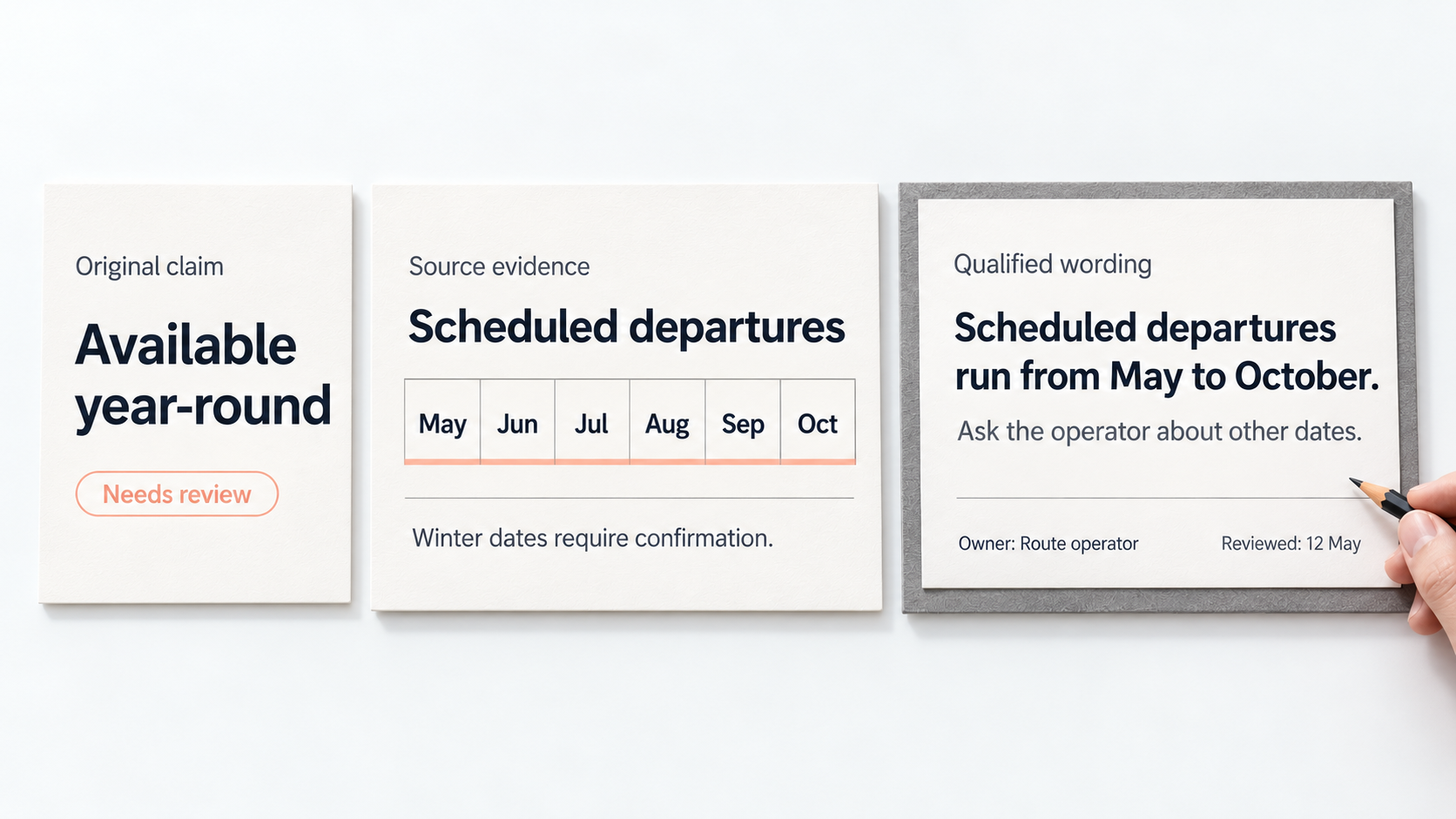
Consider a fictional route whose original operator schedule supports departures from May to October. A revised schedule for the same season now lists June to September.
The updated wording could be:
Scheduled departures run from June to September for the current season.
Availability for a particular departure still needs its own check. Retain the revised schedule and record why the published period changed.
Then examine where the earlier claim appears:
| Use | What needs attention |
|---|---|
| Journey page and translations | Update the departure period and check that the surrounding explanation still makes sense. |
| Seasonal guide | Review advice about travelling in May or October, including links that lead readers towards the journey. |
| Partner brochure | Request a review of the affected description and record whether the partner has confirmed the update. |
| Newsletter already sent | Update the maintained page it links to and decide whether the change warrants a follow-up for affected readers. |
The ledger connects these actions to the same change. It also keeps unfinished work visible.
Preserve the condition when adapting the wording
A newsletter, destination page and partner description can explain the same journey differently. Each version should retain the conditions needed to make its own wording accurate.
An email introducing quieter-season travel can lead to the journey’s maintained seasonal notes, where readers can examine dates and practical conditions before choosing.
Review translations for the same practical meaning, including the period, service and limitations. Keep each language version associated with the claim it expresses.
Check the correction and retain its history
After an edit, inspect the published result. Check the relevant sentence, nearby advice and continuation, rather than assuming a saved change has reached every use.
Record the pages or documents checked, the date and any outstanding action. For material maintained by another organization, retain the request and the response received.
Keep the previous wording with its supporting source and the reason for change. Record whether the underlying conditions changed or the earlier wording had misstated them. That history helps the next review begin from what actually happened.
Tamaga’s Source Room explains how we describe sources, evidence boundaries and corrections in our own publishing.
Bring one claim and show where it appears
Share a statement, its supporting material and a few places where it is used. We can discuss what needs to stay connected, who maintains each version and where a change could be missed.